

When viewed from the side (and the front – and the back – and yeah, maybe even from the rear), the Short 360 is arguably one of the ugliest commercial aircraft ever made.
Its boxy cross-section just reeks of something that a mechanical engineer (armed with only a T square, a protractor, and a ruler) would design.
It’s the perfect example of function over form. Practicality and efficiency was obviously the goal for the 360, as there is nothing else which can reasonably explain why it looks the way that it does.
Blank side view templates of the Shorts 360
Despite my scathing introduction to this twin engine turboprop, I’m man enough to admit that the 360 is a brilliant little aircraft with a lot of neat design details.
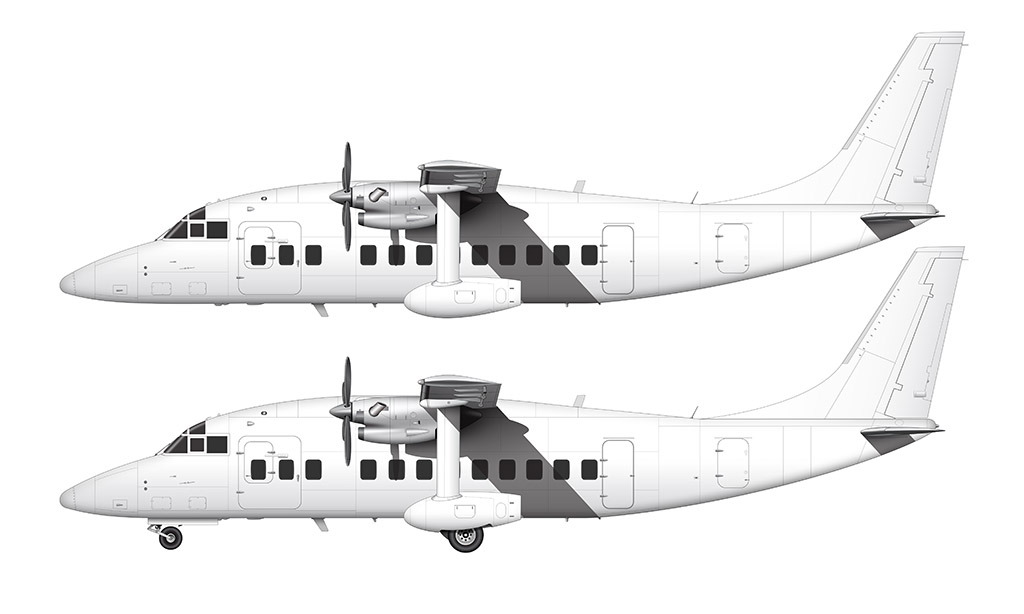
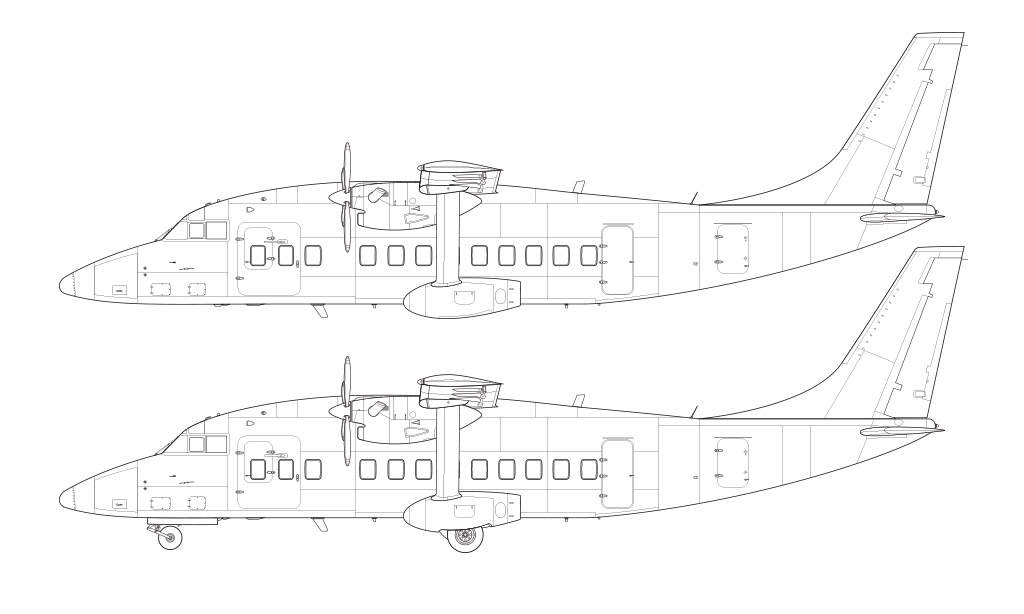
Personally, I think the most remarkable thing about the Short 360 is how successful it was despite its unconventional look. I consider it to be one of the ugliest aircraft ever made. But I can appreciate not only the engineering that went into it, but how effective it was for both cargo and passenger operations.
There were 165 produced from 1981 through 1991. It was operated by 71 airlines and two militaries (United States and Venezuela). Most Shorts 360s operated in the United Kingdom, with 18 airlines utilizing them for regional passenger service and cargo operations.
Need Larger Images?
Fully editable 5000 x 3000 px high-resolution source files for these Short 360 templates are available! Get them in JPG, PNG, PSD, and vector format.
Shorts 360 design overview
The most unique design element of the short 360 is the flat / hard edged fuselage. The cross-section is completely rectangular, which is why I often hear this aircraft being referred to as “the bread box” in the aviation community. They’re not wrong.
Unpressurized low altitude aircraft such as the 360 don’t require the rigidity that a circular fuselage cross-section provides, so the boxy cross-section was actually quite practical.
Other notable design elements include:
- An elevated cockpit. Unlike most commuter aircraft at the time, the passenger / cargo deck was lower than the flight deck. The main advantage to this was a taller ceiling, which I can only imagine provided a fairly comfortable passenger experience.
- Full size windows integrated into the cargo door. Not a very common thing in aviation. Maybe because it’s not exactly the most structurally sound thing to do? Just asking questions.
- An integrated mini door built into the primary cargo door. And it has a full size window! Part of me was expecting to be able to zoom in just a little bit closer and see yet another door and window integrated into that one…
- Exposed flap mechanisms. Look under the wing, and you’ll see the motor housings and exposed axle shafts for the flaps. Leaving all that stuff out in the open was probably really great for maintenance and repairs, but I’d imagine there was a much higher risk for potential damage.
My introduction to the Shorts 360
Before closing this out, I think it’s worth mentioning why I think about this aircraft the way that I do. It’s an important one in my history as an aviation enthusiast. As a matter of fact, it may be the aircraft that got me interested in commercial aviation.
My introduction to the Short 360 was way back in 1983 at the spry (and impressionable) age of 9. We had just dropped off my Aunt at the Flint Bishop Airport (FNT), then went up to the observation deck to watch her plane depart.
I so clearly remember seeing that Northwest Airlink Short 360 for the very first time. Even back then, at such a young age, my very first thought was of how ugly that airplane was. That was a rather damming opinion coming from a boy who lived for observing the daily bowel movements of our neighbors cows. I had a high tolerance for disgusting things, but the sight of the Short 360 was a step too far.
It got me curious about airplanes (and the airline industry) though, which makes this arguably one of the most significant aircraft of my entire life. Thankfully it didn’t take me long to become interested in real airplanes (such as the 747-200, DC-10-30, and L-1011-1), saving myself the ridicule of growing up as a Short 360 enthusiast.




Do you plan on also making a Short 330 template?
It depends on how much interest this Short 360 gets. Some of these smaller turboprops don’t get much love/attention from my audience.
Hello! Will you ever make Fairchild Swearingen Metroliner? Also love the Short 360!
Thanks Dominic! I have no immediate plans for the Metroliner, but we’ll see. As I just mentioned to @Pucca here in the comment section, it just depends on how much interest this Short 360 gets.
I second this!
Funky, but I love it!
Funky indeed! A rather nice way of saying “F’n weird” for sure lol.
What’s your next aircraft going to be?
Still thinking about it! There are so many vintage prop aircraft that I need to do (which would make my livery overviews better) but there aren’t many people who need templates for those. It’s hard to justify considering how long they take.
Could you please do Boeing 707-100 next? Would it be easy because you’ve already done the 707-320C
Norebbo, are we still getting the AN-225?
THANKS AGAIN FOR EPIC TEMPLATES
You’re very welcome Torbin!
Really love your templates, and you put a hell of a lot of effort into making them!
Thanks Aiden! You’re right, these take a lot of time to create (which is why I’m not able to produce new ones so often).
Hello! Will we ever get a boeing 377 stratocruiser? And also, amazing templates!
Thanks! Probably yes on the Stratocruiser, only because I consider it to be one of the ugliest aircraft ever made lol. It’s a neat one though. It would be fun to do I think.